
AI-Driven Autoscaling Boosts Cloud Cost Efficiency
Introduction
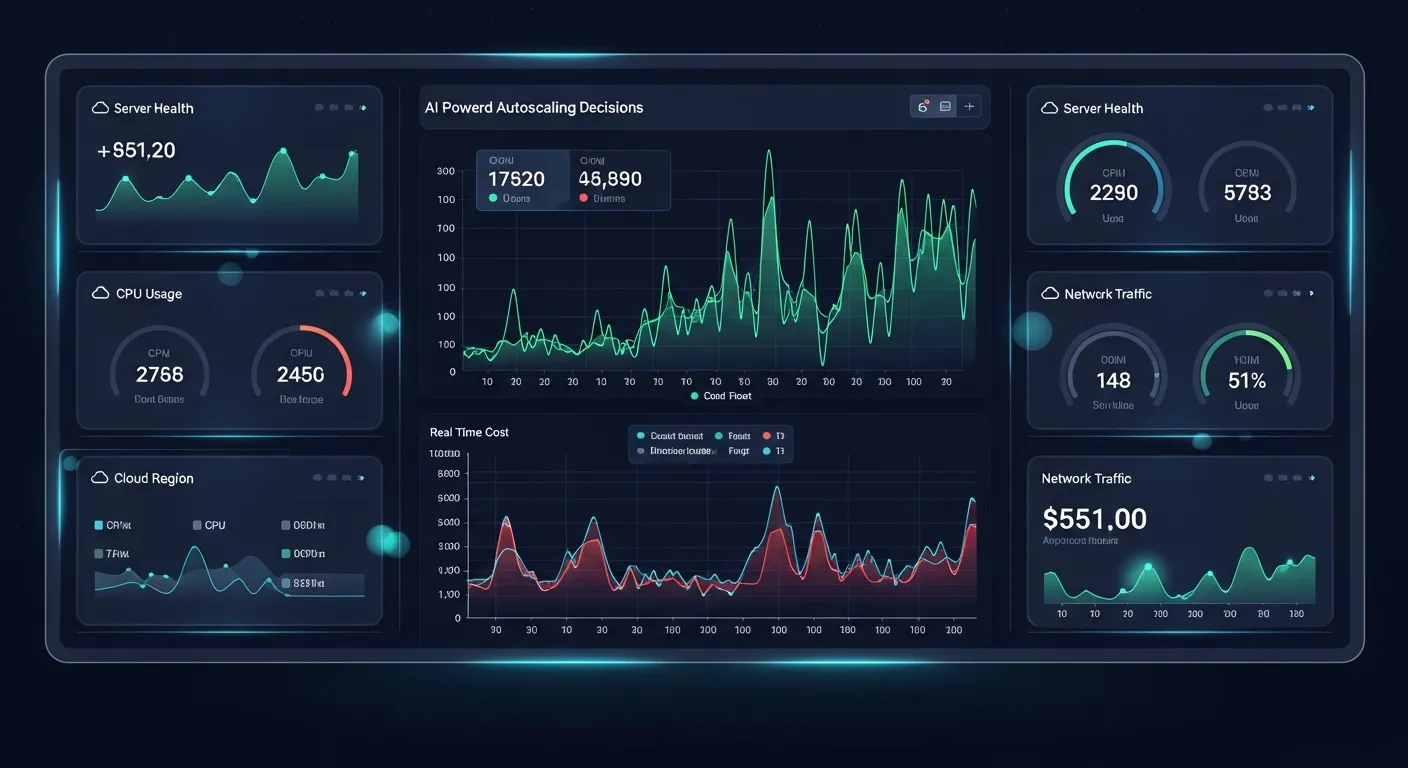
In modern cloud environments, organizations face the constant challenge of balancing performance with cost. Traditional scaling methods react to thresholds that often lead to over‑provisioning or latency spikes. AI‑driven autoscaling introduces predictive intelligence that anticipates demand, adjusts resources in real time, and delivers measurable cost savings.
Core Concept
The core idea behind AI‑driven autoscaling is to replace static rule‑based scaling with models that learn workload patterns, seasonality, and external factors. By forecasting future load, the system can provision just enough compute, storage, and networking capacity before demand peaks, and de‑allocate resources during lulls, thus reducing idle spend.
Architecture Overview
A typical AI‑driven autoscaling architecture consists of data collectors, a feature engineering layer, a predictive model service, a decision engine, and integration hooks with the cloud provider's scaling APIs. Metrics from application logs, infrastructure telemetry, and business signals feed the model, while the decision engine translates predictions into scaling actions.
Key Components
- Metric ingestion pipeline
- Feature store and preprocessing
- Machine learning prediction engine
- Policy decision engine
- Cloud provider scaling adapters
How It Works
First, real‑time metrics such as CPU usage, request latency, queue depth, and business events are streamed to a central repository. The feature store normalizes and enriches this data, creating time‑series inputs for the ML model. The model, often a recurrent neural network or gradient boosting regressor, forecasts resource demand for the next interval. The decision engine evaluates the forecast against cost and SLA constraints, generating scale‑out or scale‑in commands that are sent to the cloud provider's autoscaling API. Continuous feedback loops retrain the model with actual outcomes, improving accuracy over time.
Use Cases
- E‑commerce sites handling flash sales with unpredictable traffic spikes
- Video streaming platforms that experience daily viewership peaks
- Batch data processing pipelines with variable job queues
- IoT back‑ends processing sensor data with seasonal usage patterns
Advantages
- Reduces over‑provisioning by up to 30 percent in many workloads
- Improves SLA compliance by anticipating demand before thresholds are breached
- Automates cost optimization without manual tuning of scaling rules
- Enables granular scaling at the container or function level
Limitations
- Requires high‑quality historical data for accurate forecasting
- Model training and inference add computational overhead that must be accounted for
- Complexity of implementation may increase operational burden for small teams
Comparison
Compared with static threshold‑based autoscaling, AI‑driven approaches provide predictive capability rather than reactive adjustments. Rule‑based systems rely on fixed metrics and cannot adapt to sudden workload changes, often leading to either delayed scaling or unnecessary capacity. Serverless platforms offer automatic scaling but at a higher per‑unit cost, while AI‑driven autoscaling can fine‑tune resource allocation to achieve lower total spend.
Performance Considerations
Model latency must be low enough to issue scaling actions within the provisioning window of the target service. Choosing lightweight models or edge inference can keep decision times under a few seconds. Additionally, the scaling granularity—whether at VM, container, or function level—affects how quickly the system can respond to predictions.
Security Considerations
Access to telemetry data and scaling APIs should be protected with least‑privilege IAM roles. Model pipelines must be secured against data poisoning, and audit logs should capture every scaling decision for compliance. Encryption in transit and at rest for metric streams is essential.
Future Trends
By 2026 AI‑driven autoscaling is expected to integrate with multi‑cloud orchestrators, enabling workload migration based on cost signals across providers. Federated learning will allow models to improve without sharing raw data, enhancing privacy. Real‑time reinforcement learning may replace batch retraining, delivering near‑instant adaptation to novel traffic patterns.
Conclusion
AI‑driven autoscaling transforms cloud cost management from a reactive afterthought into a proactive, data‑powered discipline. By accurately forecasting demand and automating resource adjustments, organizations can achieve higher performance, better SLA adherence, and significant cost reductions while positioning their infrastructure for future innovations.