AI-Driven Observability: Boosting DevOps Pipelines Efficiency
Introduction
In modern software delivery, speed and reliability are no longer optional—they are essential. DevOps teams continuously seek ways to shorten feedback loops while maintaining high service quality. Observability, the practice of collecting and analyzing system signals, has become a cornerstone of this effort. The next evolution introduces artificial intelligence to make sense of massive telemetry streams, turning raw data into actionable intelligence.
Core Concept
AI-driven observability combines traditional metrics, logs, and traces with machine learning models that automatically detect anomalies, predict failures, and recommend corrective actions. Instead of static thresholds, the system learns normal behavior patterns and adapts to changes in workload, architecture, and environment.
Architecture Overview
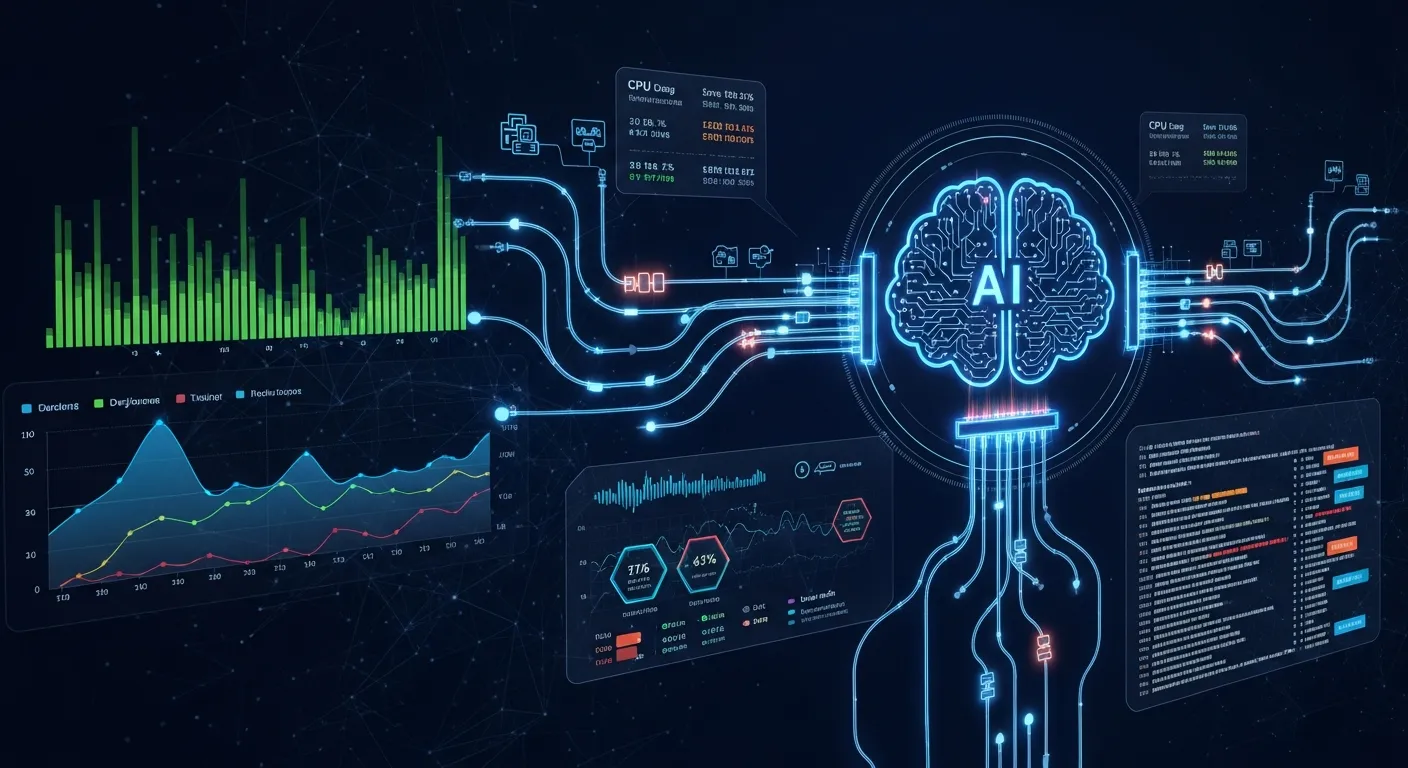
A typical AI observability stack sits between the production environment and the DevOps toolchain. Data from applications, containers, and infrastructure is ingested, normalized, and enriched. A processing engine extracts features and feeds them into trained models. The output drives dynamic alerts, visualizations, and feedback loops that can trigger automated remediation or inform continuous integration pipelines.
Key Components
- Data Ingestion Layer
- Telemetry Processing Engine
- AI Anomaly Detection Module
- Dynamic Alerting System
- Feedback Loop for CI/CD
How It Works
First, agents or sidecars collect metrics, logs, and traces and forward them to a centralized broker. The broker buffers data and applies schema validation before sending it to a stream processor. The processor aggregates signals over sliding windows and extracts statistical features such as percentile latency, error rates, and request patterns. These features are evaluated by machine learning models—often a combination of unsupervised clustering for anomaly detection and supervised forecasting for capacity planning. When a deviation exceeds a confidence threshold, the alerting system generates a context‑rich notification that includes root cause hypotheses. The notification can be consumed by incident response tools or directly fed back into the CI/CD pipeline to halt a rollout or trigger a rollback.
Use Cases
- Real-time latency detection in microservices
- Predictive capacity planning for container clusters
- Automated root cause analysis for failed deployments
Advantages
- Faster mean time to detection
- Reduced manual monitoring effort
- Proactive scaling decisions
- Improved reliability and user experience
Limitations
- High initial model training cost
- Potential false positives in noisy environments
- Dependence on quality of instrumented data
- Complexity of integration with legacy tools
Comparison
Compared to traditional rule-based monitoring, AI-driven observability offers adaptive pattern recognition, lower alert fatigue, and predictive insights while requiring more data engineering effort.
Performance Considerations
AI models add compute overhead, especially during peak traffic when feature extraction and inference must keep pace with incoming telemetry. Organizations should provision separate processing clusters, use vectorized data formats, and tune model batch sizes to balance latency and throughput. Model drift monitoring is also essential to ensure predictions remain accurate as system behavior evolves.
Security Considerations
Telemetry often contains sensitive identifiers, request payloads, and configuration details. Encrypt data in transit and at rest, enforce strict access controls on observability platforms, and apply data masking where appropriate. Model integrity must be protected against adversarial attacks that could manipulate alerts or hide malicious activity.
Future Trends
Beyond 2026, generative AI will enable natural language queries over observability data, allowing engineers to ask "Why did latency spike at 3 PM yesterday?" and receive a concise analysis. Edge observability will push lightweight inference engines to the device layer, providing instant feedback for IoT and serverless workloads. Self-healing pipelines will close the loop, using AI recommendations to automatically adjust deployment configurations, roll back faulty releases, or provision additional resources without human intervention.
Conclusion
AI-driven observability is reshaping DevOps pipelines by turning raw telemetry into predictive, actionable intelligence. While it introduces new complexities around data quality, model management, and security, the payoff in faster issue resolution, proactive scaling, and higher reliability makes it a strategic investment for organizations aiming to stay competitive in a fast‑moving cloud era.