GitOps Boosts Continuous Delivery for Faster Safer Deployments
Introduction
Continuous Delivery (CD) promises rapid, reliable software releases, but traditional CD pipelines often rely on manual steps, ad‑hoc scripts, and fragile configurations. GitOps introduces a declarative, Git‑centric model that treats the entire delivery workflow as code, enabling automated, version‑controlled, and auditable deployments. This article explores how GitOps reshapes CD, the architecture behind it, and the tangible benefits for modern software teams.
Core Concept
At its core, GitOps stores the desired state of both application and infrastructure in a Git repository. An operator continuously reconciles the live environment with the repository, applying changes only when the Git source is updated. This shift makes Git the single source of truth, turning every deployment into a traceable commit and allowing rollbacks through standard Git operations.
Architecture Overview
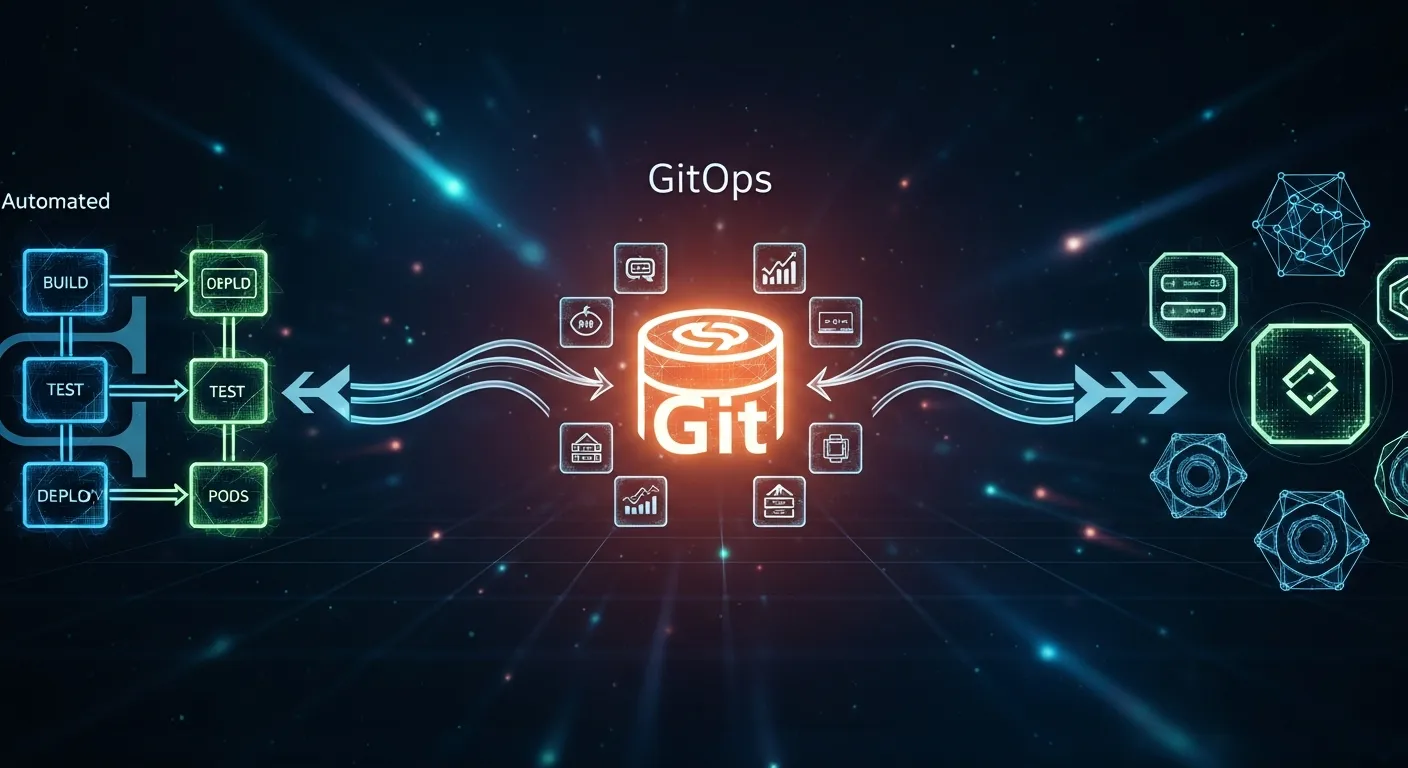
A typical GitOps‑enabled CD stack consists of a source code repository, a CI system that builds container images, a Git repository that holds Kubernetes manifests or Helm charts, and a GitOps operator such as FluxCD or ArgoCD that watches the manifests and applies them to the target clusters. Policy engines like Open Policy Agent enforce compliance before changes are applied, while observability tools provide real‑time drift detection and health checks.
Key Components
- Git repository for declarative manifests
- CI pipeline that builds artifacts
- GitOps operator (FluxCD, ArgoCD)
- Kubernetes or other declarative runtime
- Policy engine for validation
- Observability and alerting layer
How It Works
Developers push code to the version control system. The CI pipeline builds a container image, runs tests, and pushes the image to a registry. The pipeline then updates the GitOps repository with a new image tag and any configuration changes. The GitOps operator detects the commit, validates it against policies, and reconciles the target cluster to match the new desired state. If drift occurs, the operator automatically corrects it, ensuring the environment always reflects the repository.
Use Cases
- Automated rollout of microservice updates across multiple clusters
- Promotion of changes from development to staging to production using Git branches
- Infrastructure as code updates such as scaling node pools or adjusting network policies
Advantages
- Fully auditable deployments through Git commit history
- Instant rollback by reverting a Git commit
- Reduced manual intervention and configuration drift
- Consistent environments across clusters and clouds
- Improved developer experience with self‑service deployments
Limitations
- Initial learning curve for declarative tooling and GitOps operators
- Complexity when managing large numbers of microservices without proper hierarchy
- Potential latency between commit and cluster reconciliation
Comparison
Compared with traditional CD tools that use imperative scripts, GitOps provides a declarative, version‑controlled approach that is easier to audit and scale. While tools like Jenkins or Spinnaker can orchestrate deployments, they often require custom scripts for state management. GitOps eliminates that need by leveraging the Git repository as the source of truth, resulting in simpler pipelines and tighter security controls.
Performance Considerations
Operator reconciliation loops introduce a small delay, typically seconds to a few minutes, depending on cluster size and watch interval settings. Tuning the sync frequency and using lightweight manifests can minimize latency. Caching of image signatures and manifest diffs also improves performance in large environments.
Security Considerations
GitOps enforces security through signed commits, immutable Git history, and policy engines that validate manifests before they are applied. Role‑based access control (RBAC) on the Git repository and the Kubernetes cluster ensures that only authorized users can trigger changes. Additionally, secret management solutions such as Sealed Secrets or external vault integrations keep sensitive data out of the repository.
Future Trends
By 2026 GitOps is expected to extend beyond Kubernetes into serverless platforms, edge devices, and hybrid cloud orchestrators. Emerging standards like the OpenGitOps specification will promote interoperability among operators, while AI‑assisted policy generation will help teams define compliance rules automatically. Integration with GitHub Actions and GitLab CI/CD will further blur the line between CI and CD, making end‑to‑end automation a default expectation.
Conclusion
GitOps transforms Continuous Delivery from a collection of scripts into a declarative, auditable, and automated process anchored in Git. By treating infrastructure and application state as code, teams gain faster feedback, reliable rollbacks, and consistent environments across the entire delivery pipeline. While adoption requires an upfront investment in tooling and mindset, the long‑term gains in speed, security, and operational stability make GitOps a compelling evolution for modern software delivery.