GitOps Powers Continuous Delivery in Multi-Cloud Environments
Introduction
Enterprises are increasingly spreading workloads across public clouds, private data centers, and edge locations. While this multi-cloud strategy offers resilience and flexibility, it also complicates software delivery. Traditional continuous delivery pipelines often rely on bespoke scripts and manual hand‑offs that do not scale well across heterogeneous environments. GitOps introduces a declarative, Git‑centric model that unifies deployment, configuration, and lifecycle management, making continuous delivery predictable and repeatable regardless of where the workloads run.
Core Concept
At its core, GitOps treats a Git repository as the single source of truth for both application code and operational state. Desired system configuration is expressed in declarative manifests stored in Git. An automated agent continuously reconciles the live state of each target environment with the desired state defined in Git, applying changes only when a commit modifies the manifests. This feedback loop eliminates drift, provides auditability, and enables rollbacks through simple Git operations.
Architecture Overview
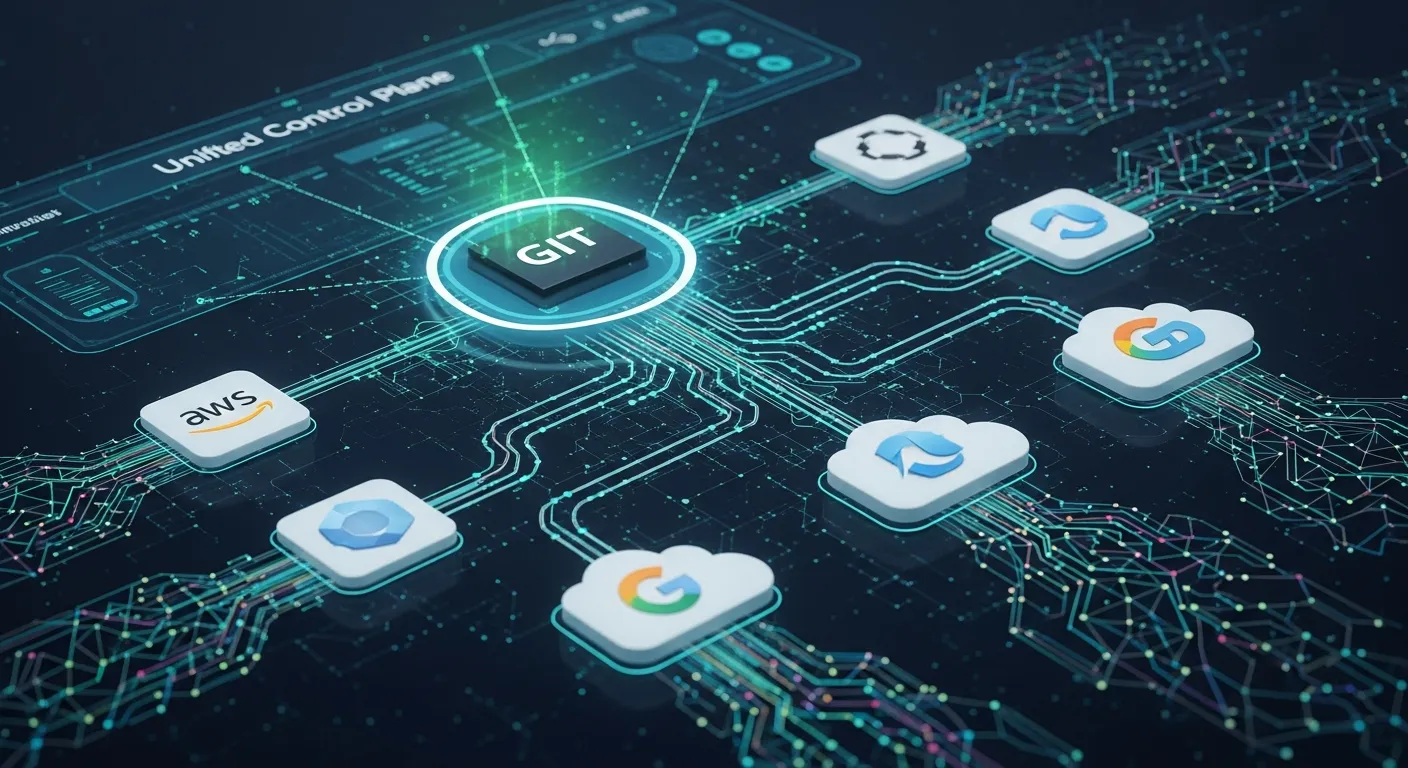
A typical multi‑cloud GitOps architecture consists of four layers. The first layer is the Git repository that holds versioned manifests for each cloud target. The second layer is a continuous integration system that builds container images and updates manifest references. The third layer comprises one or more GitOps operators, such as Argo CD or Flux, deployed in each cloud cluster. These operators watch the Git repo, pull the latest manifests, and apply them to the Kubernetes control plane. The fourth layer is the underlying cloud infrastructure – AWS, Azure, GCP, or on‑prem – each running its own Kubernetes cluster or managed service. Communication between layers is secured via mutual TLS and signed commits, ensuring that only authorized changes propagate to production.
Key Components
- Git repository as source of truth
- Declarative manifests (YAML, JSON, Helm charts)
- Continuous integration pipeline for image builds
- GitOps operator for reconciliation
- Multi‑cloud orchestrator or federation layer
- Policy engine for validation and compliance
How It Works
Developers push code changes to a feature branch. The CI system builds a container image, pushes it to a registry, and updates the image tag in the manifest stored in Git. Once the commit is merged into the main branch, the GitOps operator in each target cluster detects the new commit, validates the manifests against policy, and initiates a pull request to the cluster API. The operator then applies the changes, monitors health checks, and reports status back to the Git repository via commit status or pull‑request comments. If a deployment fails health checks, the operator automatically rolls back to the previous stable commit, ensuring continuous availability across all clouds.
Use Cases
- Zero‑downtime deployments across AWS, Azure, and GCP using a single Git workflow
- Disaster recovery with automated rollback and state synchronization across regions
Advantages
- Single source of truth eliminates configuration drift
- Auditable history of every change via Git commit logs
- Instant rollbacks by reverting commits
- Scalable across any number of clusters and clouds
- Improved developer velocity with self‑service deployments
Limitations
- Initial setup complexity for large federated environments
- Operator performance can be impacted by high frequency of commits
- Requires mature Git governance to prevent accidental changes
Comparison
Traditional CD pipelines often rely on imperative scripts that execute in a central orchestrator and push changes directly to target environments. This approach can create hidden state and makes rollbacks cumbersome. GitOps, by contrast, is declarative and fully driven by Git, providing built‑in version control and auditability. Compared to tools like Spinnaker, GitOps reduces the number of moving parts by eliminating separate deployment servers. When paired with Kubernetes native operators, GitOps achieves tighter integration with cluster APIs than generic CI/CD solutions. However, for non‑Kubernetes workloads or legacy VM‑based services, traditional pipelines may still be required.
Performance Considerations
Operator reconciliation loops should be tuned to balance freshness with API load. In high‑traffic clusters, increasing the polling interval or using webhook triggers can reduce unnecessary API calls. Multi‑cloud latency may affect the time it takes for a commit to propagate to distant regions; employing regional Git mirrors or edge caches can mitigate this. Scaling the number of managed clusters may require a hierarchical operator architecture, where a central control plane delegates reconciliation to regional agents.
Security Considerations
All Git commits affecting production must be signed and pass policy checks before reconciliation. Role‑based access control in Git and the GitOps operator ensures that only authorized users can modify manifests. Secrets should never be stored in plain text; instead, use external secret stores such as HashiCorp Vault or cloud native secret managers, with the operator injecting them at runtime. Network traffic between Git, CI, and clusters must be encrypted, and mutual TLS should be enforced for operator‑cluster communication.
Future Trends
By 2026 GitOps is expected to extend beyond Kubernetes to serverless platforms, edge devices, and even infrastructure‑as‑code tools like Terraform. AI‑driven policy engines will automatically suggest optimal manifest configurations based on observed performance patterns. Multi‑cloud GitOps controllers will provide native support for workload federation, allowing a single deployment to span multiple clouds with automated cost and latency optimization. Integration with observability platforms will enable closed‑loop remediation, where incidents trigger automatic Git rollbacks.
Conclusion
GitOps offers a powerful paradigm for achieving continuous delivery across complex multi‑cloud landscapes. By treating Git as the definitive source of truth and leveraging declarative reconciliation, organizations gain consistency, auditability, and rapid recovery capabilities. While adoption requires careful planning around governance, performance tuning, and security, the long‑term benefits of reduced operational overhead and accelerated innovation make GitOps a cornerstone of modern cloud‑native delivery pipelines.