GitOps Powers Scalable Continuous Delivery
Introduction
In modern software engineering the demand for faster releases and higher reliability has pushed organizations to adopt continuous delivery at scale. GitOps offers a declarative, version‑controlled approach that aligns infrastructure and application changes with the same Git workflow used by developers, making large‑scale automation both predictable and auditable.
Core Concept
GitOps is built on the principle that the desired state of a system is stored in Git and an automated agent continuously reconciles the live environment to match that state. By treating Git as the single source of truth, teams can apply pull‑request based change management to infrastructure, configuration, and application code alike.
Architecture Overview
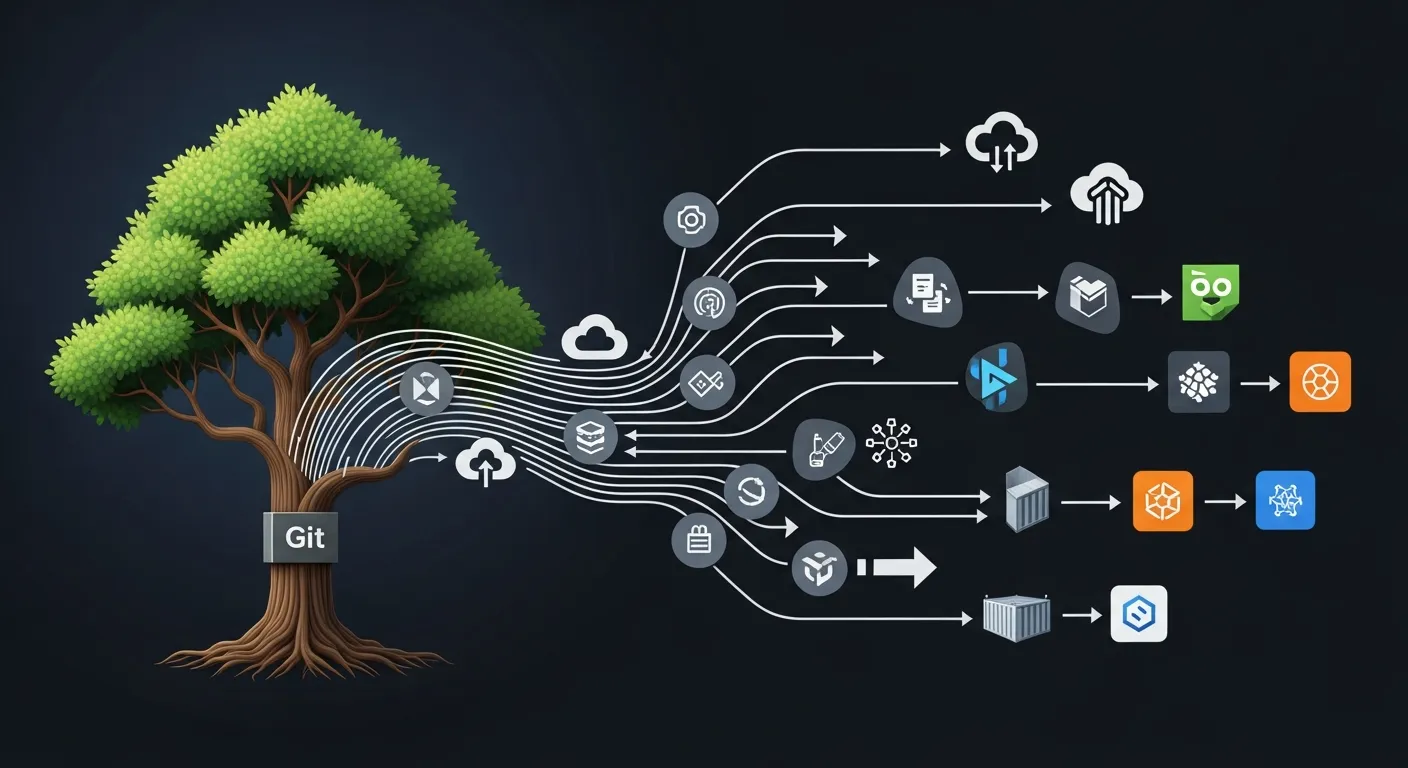
A typical GitOps architecture consists of a Git repository that holds manifests, a continuous integration pipeline that builds container images, and a continuous deployment engine that watches the repository and applies changes to target clusters. The deployment engine interacts with the Kubernetes API or other orchestration layers to enforce the declared state, while monitoring tools provide drift detection and alerting.
Key Components
- Git Repository
- Kubernetes Cluster
- FluxCD or ArgoCD
- CI Pipeline
- Policy Engine
How It Works
Developers push code changes to a feature branch and create a pull request. The CI pipeline builds the container image, runs tests, and tags the image. The pull request also updates the deployment manifest with the new image tag. Once the pull request is merged, the GitOps controller detects the manifest change, pulls the updated files, and applies them to the target cluster. If the live state diverges, the controller automatically rolls back or alerts operators.
Use Cases
- Microservice rollout across multiple clusters
- Feature flag driven releases
- Multi-tenant SaaS updates
Advantages
- Single source of truth eliminates configuration drift
- Auditable change history through Git logs
- Automated reconciliation reduces manual errors
- Scales horizontally across many clusters and teams
- Improves developer velocity with pull‑request workflows
Limitations
- Initial learning curve for GitOps tooling
- Requires robust Git governance to prevent accidental changes
- Complexity grows with heterogeneous environments
- Limited support for legacy non‑declarative systems
Comparison
Compared with traditional scripted deployments, GitOps provides declarative intent and continuous reconciliation, while classic CI/CD pipelines rely on one‑time execution scripts. Tools like Jenkins or Spinnaker can achieve similar outcomes but often lack built‑in drift detection and Git‑centric audit trails. GitOps complements rather than replaces CI, focusing on the deployment phase and environment state management.
Performance Considerations
The reconciliation loop frequency should balance freshness with cluster load; typical intervals range from 30 seconds to a few minutes. Large manifest repositories benefit from selective syncing or hierarchical structures to reduce API calls. Image caching and layered container builds further improve rollout speed in high‑throughput environments.
Security Considerations
GitOps enforces policy as code; integrating OPA or Kyverno enables automated validation of manifests before they reach the cluster. Role‑based access control on the Git repository and the deployment engine prevents unauthorized changes. Secrets management must be externalized using tools like Sealed Secrets or HashiCorp Vault to avoid plain‑text storage in Git.
Future Trends
By 2026 GitOps is expected to expand beyond Kubernetes into serverless platforms and edge computing devices, driven by standardized declarative APIs. AI‑assisted drift prediction and self‑healing loops will augment human operators, while tighter integration with policy‑as‑code frameworks will make compliance enforcement fully automated.
Conclusion
GitOps bridges the gap between development and operations by turning Git into the control plane for continuous delivery. Its declarative, automated, and auditable nature makes it uniquely suited for scaling delivery pipelines across complex, multi‑cluster environments. While adoption requires cultural and tooling investment, the payoff in reliability, speed, and compliance positions GitOps as a cornerstone of modern cloud‑native delivery strategies.