GitOps: Speeding Up DevOps Pipelines for Faster Delivery
Introduction
In today’s competitive software landscape organizations strive to deliver features quickly while maintaining stability. DevOps practices have shortened release cycles, yet many teams still wrestle with manual configuration drift and fragmented tooling. GitOps emerges as a paradigm that treats Git repositories as the authoritative source for both application and infrastructure state, promising tighter feedback loops and higher reliability across the entire delivery pipeline.
Core Concept
At its core GitOps extends the declarative model of infrastructure as code by coupling it with continuous reconciliation. Desired system state is stored as code in a Git repository. Automated agents monitor the repository for changes, apply them to target environments, and continuously verify that the live state matches the declared state. This creates a self‑healing loop that reduces human intervention and makes every change auditable.
Architecture Overview
A typical GitOps architecture consists of a version‑controlled Git repository, a CI system that builds artifacts, and one or more operators that pull changes from Git and enforce them on target clusters. The CI pipeline publishes container images and updates manifests, while the operator reconciles those manifests with the actual cluster state. Observability tools feed back status and alert on drift, completing the loop.
Key Components
- Git Repository as source of truth
- Declarative configuration files
- CI system for building and testing
- GitOps operator or controller
- Observability and alerting stack
How It Works
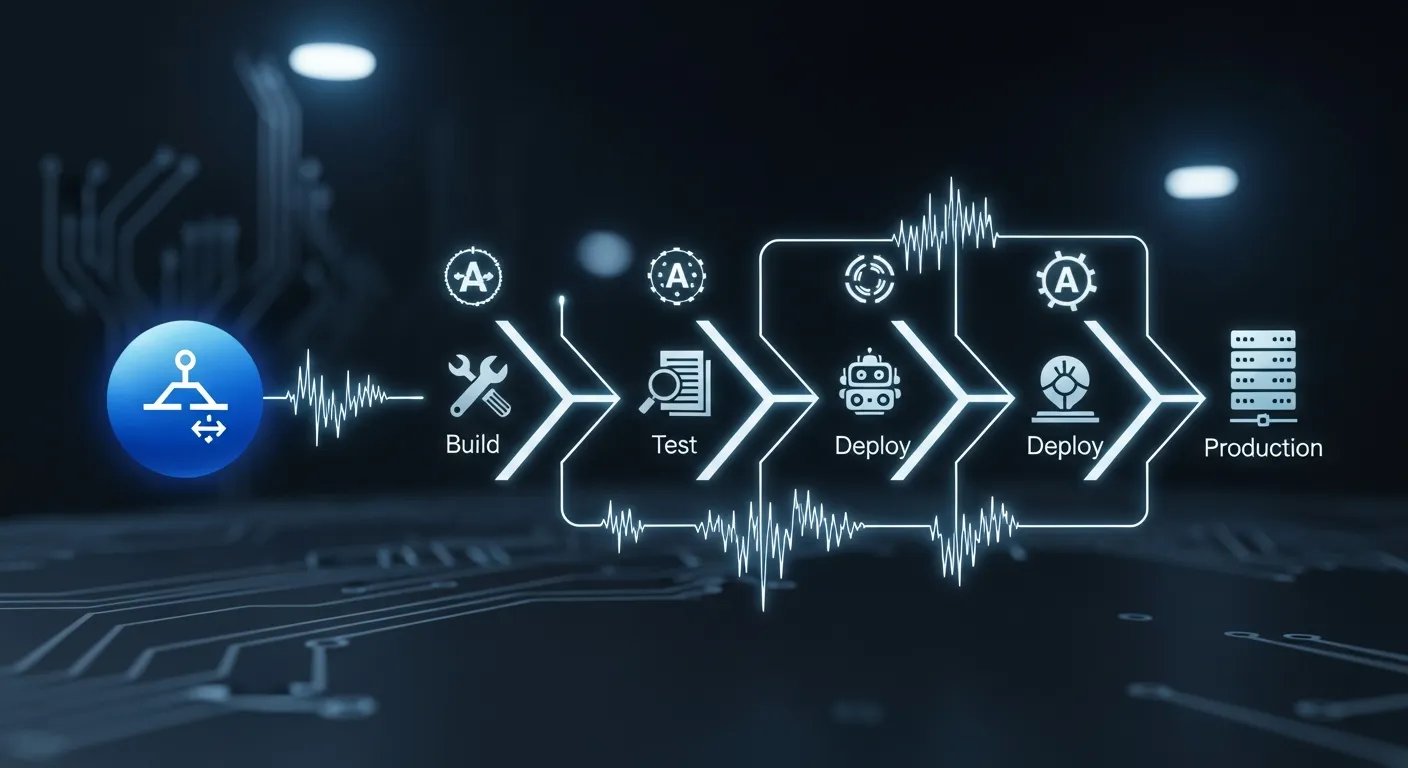
When a developer pushes a change to the Git repo, the CI pipeline validates the code, builds containers, and updates the manifest files with new image tags. The GitOps operator watches the repo, detects the new commit, and applies the updated manifests to the target environment using the platform API. After deployment the operator continuously compares the live state with the desired state; any divergence triggers a corrective action or an alert, ensuring the system remains in sync with Git.
Use Cases
- Continuous deployment of microservices across multiple clusters
- Automated provisioning of cloud resources with IaC tools
- Feature flag rollouts managed through versioned manifests
- Compliance enforcement by storing policy as code in Git
- Disaster recovery through reproducible environment definitions
Advantages
- Consistent state across all environments
- Reduced manual configuration errors
- Faster mean time to recovery through self‑healing loops
- Improved auditability and traceability of changes
- Scalable automation that works across many clusters
Limitations
- Steep learning curve for teams new to declarative workflows
- Tooling fragmentation can lead to integration challenges
- Complexity grows with large monorepos and many services
- Limited support for legacy systems that lack API access
- Potential over‑reliance on Git leading to bottlenecks if not managed
Comparison
Traditional scripted CI/CD pipelines often rely on imperative commands executed by a central server, making state drift harder to detect. Terraform workflows provide declarative infrastructure but typically separate application deployment, requiring additional glue code. GitOps unifies both by using the same Git repo for all desired state, offering tighter coupling between code and infrastructure and eliminating the need for custom scripts to enforce consistency.
Performance Considerations
The speed of the reconciliation loop depends on the operator polling interval, Git server latency, and the size of the manifest set. Scaling GitOps to hundreds of clusters may require sharding repositories or using lightweight agents that subscribe to webhook events instead of frequent polling. Caching of API calls and incremental diff calculations can further reduce overhead.
Security Considerations
Since Git becomes the single source of truth, protecting the repository is critical. Organizations should enforce signed commits, branch protection rules, and least‑privilege access for automation accounts. Secrets must be stored outside the repo using vault solutions and referenced via sealed secrets or external secret stores. Operators should run with minimal permissions required to apply changes, reducing the blast radius of a compromised credential.
Future Trends
Looking beyond 2026 GitOps is expected to integrate AI‑driven policy recommendation engines that suggest optimal manifest configurations based on observed performance. Serverless and edge computing platforms are adopting lightweight GitOps controllers to manage functions at scale. Policy‑as‑code frameworks will blend security and compliance directly into the Git workflow, and multi‑cloud orchestration will rely on federated GitOps models that coordinate state across providers without vendor lock‑in.
Conclusion
GitOps reshapes DevOps pipelines by turning Git into the definitive ledger of system intent, automating deployment, and continuously ensuring compliance between desired and actual state. While it introduces new operational considerations, the gains in speed, reliability, and auditability make it a compelling strategy for organizations aiming to accelerate software delivery while maintaining robust governance.