How GitOps Boosts CI/CD Efficiency and Accelerates Delivery
Introduction
In modern software engineering, speed and reliability are paramount. Traditional CI/CD workflows often involve disparate tools, manual handoffs, and configuration drift. GitOps introduces a declarative, version‑controlled approach that aligns infrastructure and application delivery with the same principles used for source code, dramatically improving pipeline efficiency.
Core Concept
GitOps treats a Git repository as the single source of truth for both application code and the desired state of the runtime environment. Changes are made through pull requests, validated by automated pipelines, and reconciled by operators that continuously enforce the declared state in the target platform.
Architecture Overview
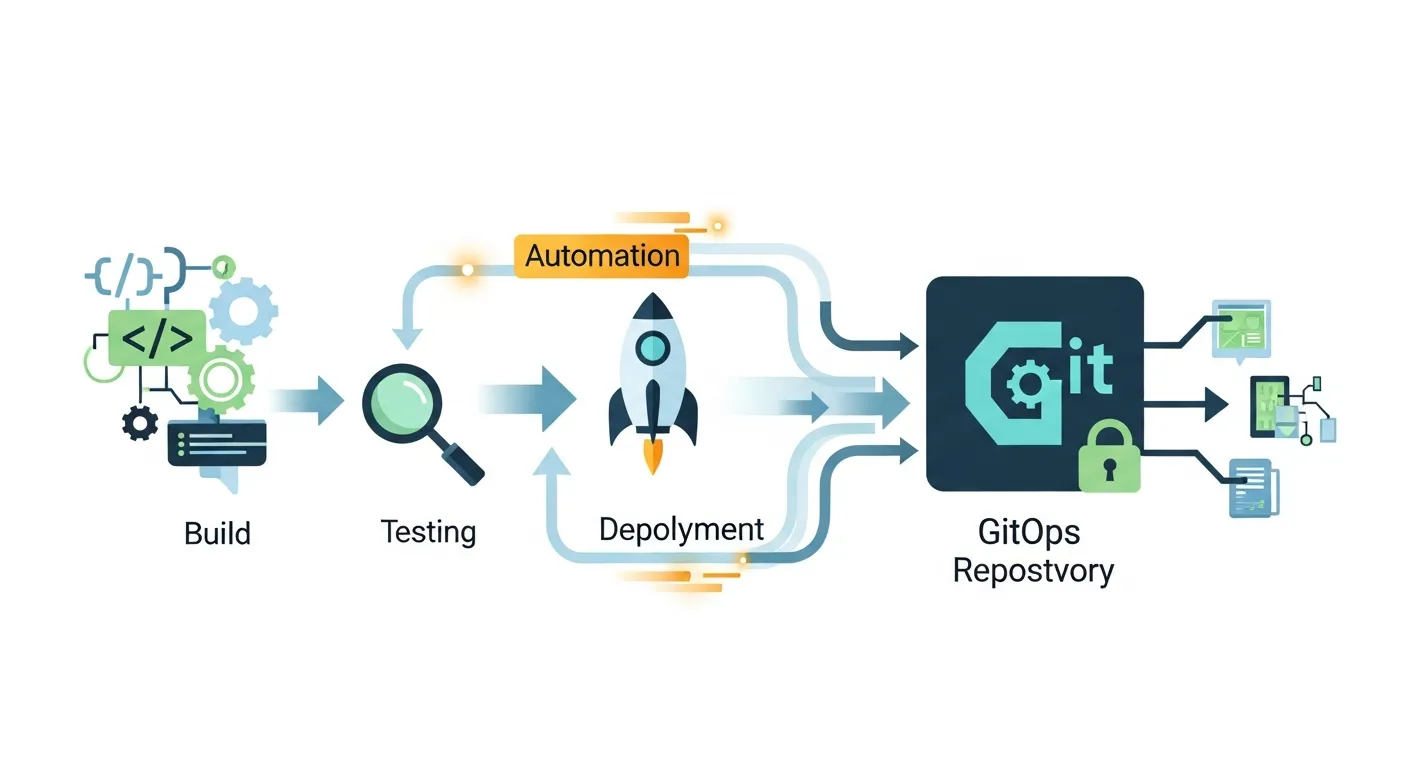
A typical GitOps architecture consists of a central Git repo storing manifests, a CI system that builds artifacts and updates the repo, an operator or controller that watches the repo and applies changes to the cluster, and a monitoring layer that reports drift. This closed loop eliminates manual steps and ensures that what is in Git is exactly what runs in production.
Key Components
- Git repository as source of truth
- Continuous Integration pipeline
- GitOps operator or controller
- Target platform (Kubernetes, cloud services)
- Secret and configuration management
How It Works
Developers push code changes to a feature branch. The CI pipeline builds the container image, runs tests, and on success updates the GitOps repo with a new image tag and any required configuration changes. The operator detects the commit, validates the manifest, and applies it to the cluster. If the live state diverges, the operator reconciles it back to the desired state, providing automatic rollback if needed.
Use Cases
- Automated production deployments with zero‑touch promotion
- Multi‑environment consistency across dev, staging, and prod
- Disaster recovery by re‑applying the last known good Git state
- Policy‑driven rollouts using Git branch protections
Advantages
- Reduced mean time to recovery through declarative rollbacks
- Improved auditability because every change is a Git commit
- Higher developer productivity with familiar pull‑request workflow
- Consistent environments that prevent configuration drift
Limitations
- Initial learning curve for teams new to declarative infrastructure
- Operator complexity can increase with custom resource definitions
- Git repository becomes a critical single point of failure if not replicated
Comparison
Compared with traditional CI/CD, GitOps adds a continuous reconciliation layer that automates post‑deployment drift correction. Unlike pure IaC tools that require manual apply commands, GitOps continuously watches the repo, offering self‑healing capabilities. Traditional pipelines may still rely on scripts and manual approvals, whereas GitOps enforces policy through Git permissions and automated checks.
Performance Considerations
Operator sync intervals and webhook latency influence how quickly changes propagate. Large manifest repositories benefit from selective watching or hierarchical repos to reduce load. Caching of image layers and using lightweight diff algorithms can further speed up reconciliations.
Security Considerations
Storing secrets in encrypted form within Git or using external secret managers prevents credential leakage. Role‑based access control on the repository enforces who can modify production manifests. Operators must run with least‑privilege permissions to limit blast radius in case of compromise.
Future Trends
By 2026 GitOps is expected to expand beyond Kubernetes into serverless and edge computing platforms. AI‑driven policy engines will suggest optimal manifest changes, while multi‑cloud GitOps controllers will orchestrate resources across heterogeneous environments, making the paradigm the backbone of universal continuous delivery.
Conclusion
GitOps bridges the gap between development and operations by turning infrastructure into code that lives in Git. This shift reduces manual effort, improves reliability, and accelerates delivery cycles, making it a compelling evolution for any organization seeking efficient, scalable CI/CD pipelines.