Observability Stack: Seamless Traces Metrics Logs Integration
Introduction
In modern cloud native environments the volume of data generated by services can be overwhelming. Teams that rely on isolated monitoring tools often miss the bigger picture, leading to longer mean time to resolution and higher operational cost. An observability stack that brings together traces, metrics and logs provides a single source of truth that empowers engineers to understand system behavior end to end. This article explains why integration matters, outlines a reference architecture, and shares practical guidance for building a resilient stack that scales with your workloads.
Core Concept
Observability is more than just monitoring. It is the ability to infer the internal state of a system based on the data it produces. Traces capture the flow of requests across services, metrics provide quantitative measurements of performance, and logs record detailed event information. When these three pillars are correlated, you can answer complex questions such as why a latency spike occurred, which code path contributed to an error, and how resource utilization changed over time.
Architecture Overview
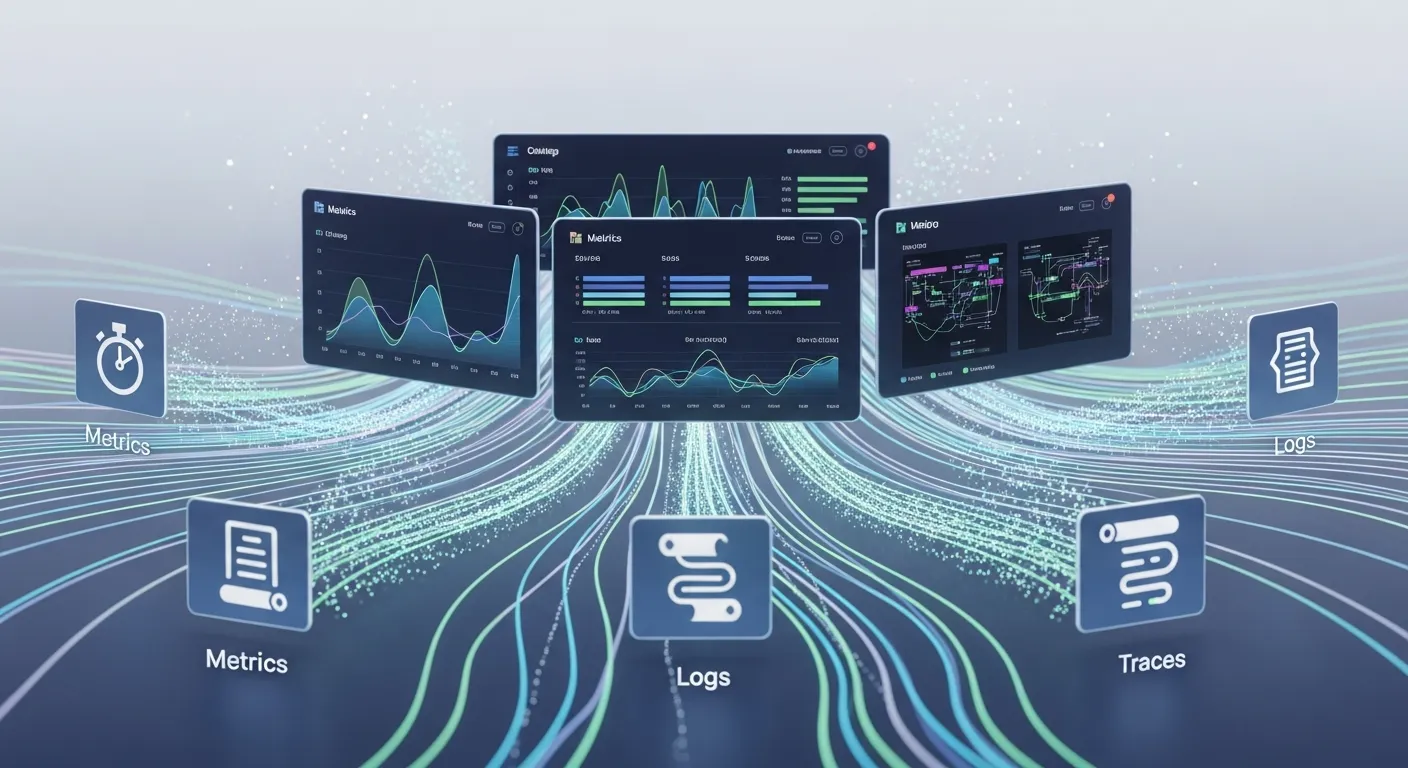
A typical integrated observability stack consists of data collectors, a centralized storage layer, processing pipelines, and visualization dashboards. Agents or sidecars on each host capture raw traces, metrics and logs and forward them to a message broker or directly to a backend. The backend stores time series data for metrics, indexed documents for logs and trace spans in a specialized trace store. Correlation identifiers such as trace IDs are propagated across all data types, enabling joint queries. Query engines expose APIs that power dashboards, alerting systems and AI based anomaly detection.
Key Components
- Instrumentation libraries
- Data collectors and sidecars
- Message broker or streaming platform
- Time series database
- Log indexing engine
- Trace storage and retrieval service
- Correlation engine
- Visualization and alerting layer
How It Works
When a request enters the system the instrumentation library generates a unique trace identifier. This ID is attached to every subsequent call, metric label and log entry. Metrics are emitted at regular intervals by exporters, while logs are streamed as they occur. All data is sent to a collector that tags each record with the trace ID before forwarding it to the broker. The broker buffers the streams and delivers them to the appropriate storage backends. A correlation engine reads the IDs and builds relationships so that a user can start from a high level metric chart, drill down to a specific log entry and then follow the full trace across services. Query APIs allow joint searches across the three data domains, enabling powerful root cause analysis.
Use Cases
- End to end latency troubleshooting
- Error correlation across microservices
- Capacity planning with combined metrics and logs
- Security incident investigation using trace enriched logs
- Automated anomaly detection with multi‑signal models
Advantages
- Faster mean time to resolution
- Reduced operational silos
- Improved root cause accuracy
- Better resource optimization
- Unified alerting reduces noise
Limitations
- Increased storage cost for raw data retention
- Complexity of managing multiple data pipelines
- Potential performance impact from heavy instrumentation
Comparison
Traditional monitoring stacks often treat metrics, logs and traces as separate silos. Solutions like standalone Prometheus focus on metrics only, while Elastic Stack emphasizes logs and Grafana Loki adds log aggregation. Distributed tracing tools such as Jaeger or Zipkin provide deep request visibility but lack native metric correlation. An integrated stack combines the strengths of each, offering joint queries and a single UI, whereas separate tools require manual correlation and multiple dashboards.
Performance Considerations
Sampling rates must be tuned to balance visibility and overhead. High‑frequency metrics and full trace collection can saturate network bandwidth and storage. Use adaptive sampling for traces, aggregate metrics at the edge, and compress logs before ingestion. Deploy collectors close to the source to reduce latency and leverage back‑pressure mechanisms in the broker to avoid data loss during spikes.
Security Considerations
Data in transit should be encrypted with TLS and access to storage backends must be controlled via role based policies. Sensitive information such as user identifiers should be masked or tokenized before logs are indexed. Auditing of query activity helps detect misuse of observability data. Ensure that trace IDs are not guessable to prevent correlation attacks.
Future Trends
By 2026 observability platforms will increasingly embed AI models that automatically correlate signals across traces, metrics and logs to suggest remediation steps. OpenTelemetry will become the de facto standard for unified instrumentation, reducing vendor lock‑in. Edge computing will push collectors further into the network, enabling near real time analysis with minimal latency. Privacy‑preserving observability, using techniques like differential privacy, will address regulatory concerns while still providing actionable insights.
Conclusion
Integrating traces, metrics and logs into a single observability stack transforms raw data into actionable intelligence. While the implementation requires careful planning around instrumentation, data pipelines and storage, the benefits of faster troubleshooting, reduced downtime and informed capacity decisions far outweigh the added complexity. By following the architectural guidelines and best practices outlined in this guide, organizations can build a future‑proof observability foundation that scales with their cloud native workloads.