Why Containers Are Replacing VMs in Modern Infra
Introduction
The rise of cloud-native applications has forced organizations to rethink traditional server provisioning. Virtual machines served well for decades, but they bring overhead that slows down innovation. Container-native infrastructure offers a lightweight, portable alternative that aligns with modern development pipelines and operational practices.
Core Concept
At its core, container-native infrastructure treats containers as first-class citizens. Rather than layering containers on top of a heavyweight hypervisor, the platform is built around a container runtime, an orchestrator, and a set of networking and storage plugins that work together to provide a seamless execution environment.
Architecture Overview
A typical container-native stack consists of a host operating system, a container runtime such as containerd or cri-o, an orchestrator like Kubernetes, an image registry for storing immutable container images, and a network fabric managed by CNI plugins. Together these components replace the monolithic hypervisor and guest OS model of VMs.
Key Components
- Container Runtime
- Orchestrator
- Image Registry
- CNI Plugin
- Service Mesh
How It Works
Developers package code and dependencies into a container image. The image is pushed to a registry. When deployment is required, the orchestrator schedules the container onto a suitable node, pulls the image, and starts it using the container runtime. The CNI plugin configures network namespaces, while storage drivers attach persistent volumes. The orchestrator continuously monitors health and can scale replicas up or down based on demand.
Use Cases
- Microservices deployment
- CI/CD pipelines
- Edge computing
- Hybrid cloud workloads
Advantages
- Reduced resource overhead compared to full guest OS
- Faster start‑up times enable rapid scaling
- Consistent environments from development to production
- Improved density leads to lower infrastructure cost
- Native integration with DevOps tooling
Limitations
- Limited isolation compared to hardware‑level VM security
- Stateful workloads may require additional storage orchestration
- Learning curve for teams transitioning from VM management
Comparison
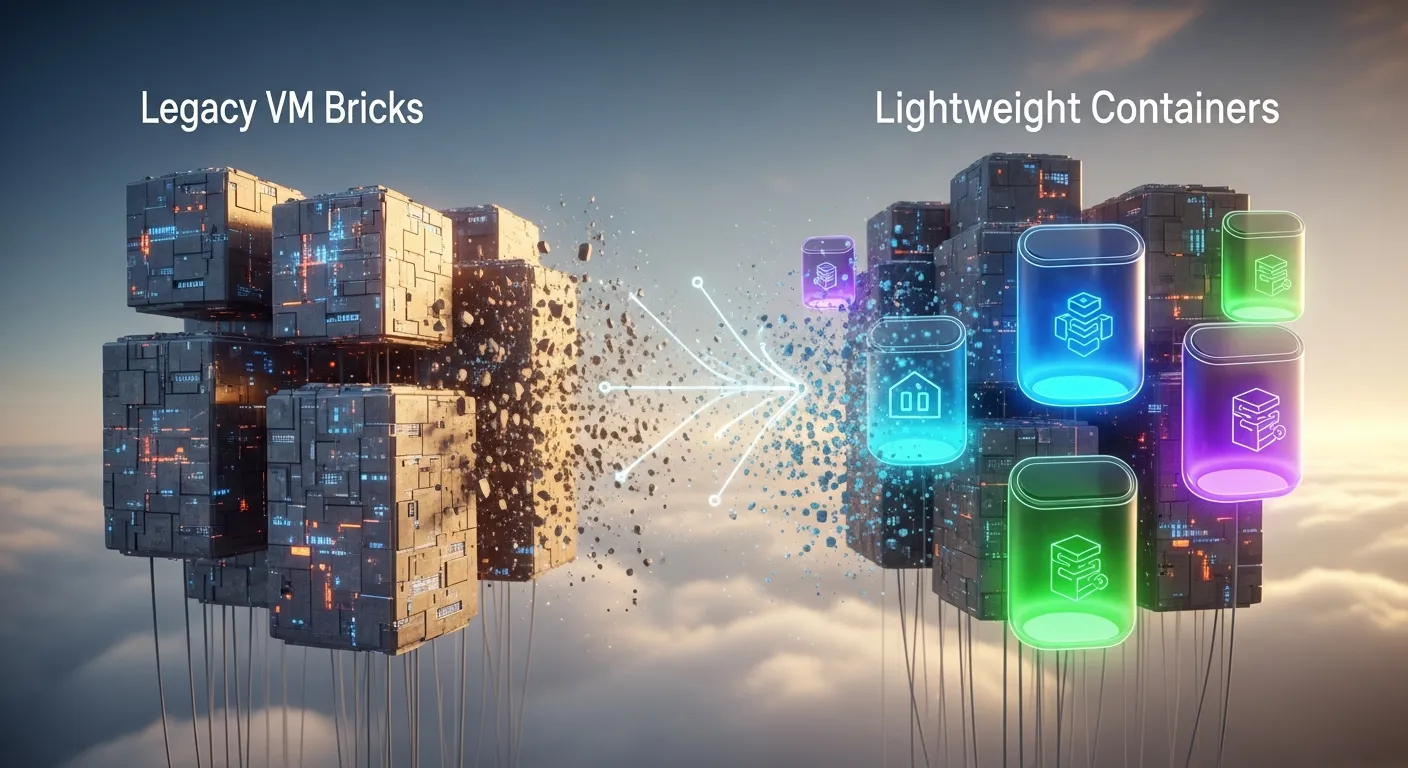
Compared with VMs, containers share the host kernel, eliminating the need for separate guest operating systems. This yields higher compute efficiency but sacrifices the strong isolation guarantees that hypervisors provide. Serverless functions and bare‑metal provisioning represent other alternatives, each with its own trade‑offs in flexibility, performance, and operational complexity.
Performance Considerations
Containers typically achieve near‑native CPU performance because they avoid hypervisor translation layers. Memory overhead is also lower, allowing more workloads per node. However, noisy neighbor effects can arise when multiple containers compete for shared kernel resources, so resource quotas and cgroup limits are essential for predictable performance.
Security Considerations
Security in container-native environments relies on kernel hardening, namespace isolation, and image scanning. Runtime security tools enforce policies, while signed images prevent tampering. For workloads requiring stronger isolation, technologies such as gVisor, Kata Containers, or hardware‑assisted virtualization can be layered on top of containers.
Future Trends
By 2026 the line between VMs and containers will blur further as lightweight virtual machines like Firecracker gain traction for multi‑tenant SaaS platforms. Advances in eBPF will provide deeper visibility and security enforcement without compromising performance. Edge deployments will favor container‑native stacks because of their minimal footprint, while AI workloads will drive new orchestration primitives for GPU sharing and model lifecycle management.
Conclusion
The shift from VMs to container-native infrastructure is driven by the need for speed, efficiency, and agility in cloud‑centric environments. While containers are not a universal replacement for every workload, they have become the default execution model for modern applications. Organizations that adopt a well‑architected container platform can unlock faster time‑to‑market, lower costs, and a foundation ready for emerging technologies.