Why GitOps Is the Future of Cloud Native Deployments
Introduction
Enterprises are moving faster than ever to deliver software at scale. Traditional deployment pipelines struggle with manual steps, drift, and lack of auditability. GitOps introduces a declarative, version controlled approach that aligns infrastructure management with modern software development practices, making it a natural fit for cloud native environments.
Core Concept
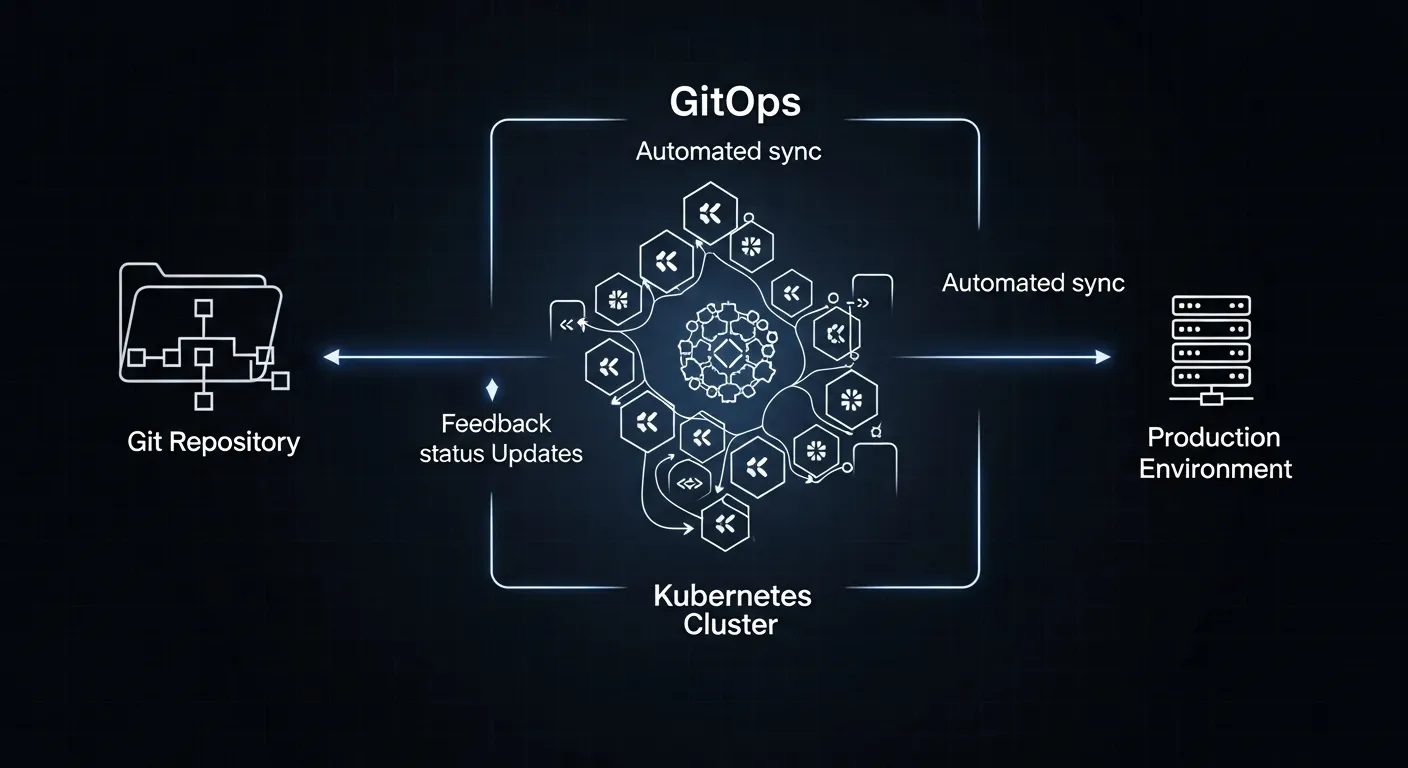
At its core GitOps treats the desired state of an entire system as code stored in a Git repository. Automated agents continuously reconcile the live environment with the Git source, applying changes only when they are committed and passing predefined validation steps.
Architecture Overview
A typical GitOps stack consists of a source control layer, a CI pipeline that builds artifacts, a Git repository that holds manifests, and a continuous reconciliation engine such as Argo CD or Flux that watches the repo and applies changes to the Kubernetes cluster. Observability and policy enforcement are integrated through webhooks and admission controllers.
Key Components
- Git repository as single source of truth
- Declarative manifests (Helm, Kustomize, Jsonnet)
- Continuous reconciliation engine
- CI pipeline for artifact creation
- Policy engine for validation and security
How It Works
Developers push a change to the Git repo. The CI system builds container images and updates the manifest references. The reconciliation engine detects the new commit, validates it against policies, and then applies the changes to the cluster using server side apply. If drift occurs, the engine reverts the cluster back to the declared state, ensuring consistency.
Use Cases
- Multi‑cluster management across regions
- Zero‑downtime progressive rollouts
- Self‑service environments for internal teams
- Disaster recovery with declarative state
- Compliance enforcement through immutable Git history
Advantages
- Full audit trail via Git commit history
- Reduced human error through automation
- Faster recovery from configuration drift
- Improved collaboration between developers and operators
- Scalable management of hundreds of clusters
Limitations
- Initial learning curve for teams new to declarative workflows
- Complexity in handling secret management without proper tooling
- Potential latency between commit and cluster state in large environments
Comparison
Compared to traditional scripted deployments, GitOps offers immutable version control, automated drift correction and better auditability. While tools like Terraform provide infrastructure as code, GitOps extends the concept to continuous delivery by tying the deployment loop directly to Git, making it more suitable for dynamic Kubernetes workloads.
Performance Considerations
Reconciliation frequency should balance speed of change propagation with API server load. Large manifest sets benefit from hierarchical structuring and selective syncing. Caching layers in the engine can reduce latency, but must be tuned to avoid stale state.
Security Considerations
Access to the Git repository must be tightly controlled using least‑privilege principles. Secrets should be stored in external vaults and referenced via sealed secrets or SOPS. Policy engines such as OPA can enforce compliance before changes reach the cluster.
Future Trends
By 2026 GitOps will converge with AI‑driven policy recommendation, enabling predictive scaling and automated remediation. Integration with service meshes and serverless platforms will broaden its applicability beyond Kubernetes, making GitOps a universal control plane for cloud native ecosystems.
Conclusion
GitOps unifies code and operations under a single, auditable workflow that scales with modern cloud native demands. Its declarative, automated nature reduces risk, accelerates delivery, and prepares organizations for the increasingly complex multi‑cloud future.