Why GitOps Supercharges Modern DevOps Workflows
Introduction
In today's fast‑moving software landscape organizations seek ways to deliver value quickly while maintaining stability. GitOps emerges as a powerful extension of DevOps principles, using Git as the single source of truth for both application and infrastructure code. This approach reshapes how teams collaborate, automate, and govern their delivery pipelines.
Core Concept
GitOps is a set of practices that leverages declarative descriptions of desired system state stored in Git repositories. Automated agents continuously reconcile the live environment with the Git‑defined state, ensuring that any drift is corrected automatically.
Architecture Overview
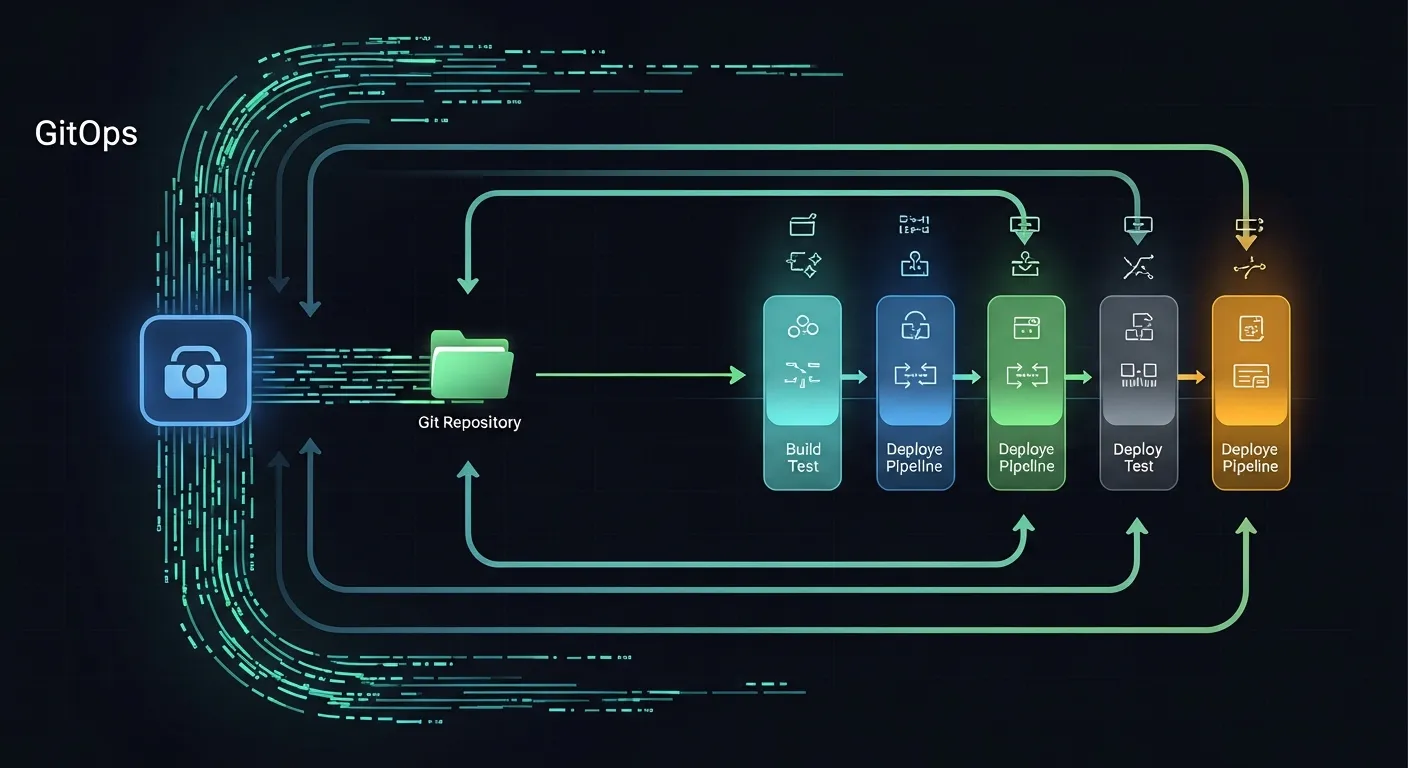
A typical GitOps architecture consists of a version‑controlled Git repository, a continuous integration pipeline that builds and packages artifacts, and a continuous deployment engine that watches the repository for changes. When a new commit appears, the deployment engine applies the updated manifests to the target platform, such as Kubernetes, using operators or controllers that enforce the declared state.
Key Components
- Git repository
- CI/CD pipeline
- Kubernetes cluster
- Operator or controller
- Observability and monitoring tools
How It Works
Developers push declarative configuration files to a Git branch. The CI system builds container images and updates image tags in the manifests. A GitOps controller monitors the branch, detects the change, and triggers a sync operation that applies the manifests to the cluster. If the live state diverges, the controller rolls back or alerts operators, keeping the system aligned with the repository.
Use Cases
- Automated environment provisioning for development, staging, and production
- Continuous delivery of microservices with zero‑downtime deployments
- Disaster recovery by restoring infrastructure from Git history
Advantages
- Immutable infrastructure and repeatable deployments
- Rapid rollback to any previous commit
- Full audit trail of all changes in Git
- Developer self‑service without manual scripting
Limitations
- Steep learning curve for teams new to Git‑centric workflows
- Tooling maturity varies across cloud providers
- Complexity when managing large monorepos with many services
Comparison
Traditional scripted CI/CD pipelines often rely on ad‑hoc scripts and manual steps, making reproducibility and auditability harder. GitOps replaces custom scripts with declarative manifests stored in Git, providing a clear, versioned source of truth and automated reconciliation that traditional approaches lack.
Performance Considerations
Repository size and frequency of sync operations affect latency. Large manifests can slow reconciliation, so splitting configurations into smaller, modular repositories or using hierarchical overlays helps maintain fast deployment cycles. Monitoring sync duration and resource usage of controllers is essential for scaling.
Security Considerations
Access to the Git repository must be tightly controlled with role‑based permissions. Signed commits and GPG verification add authenticity. Secrets should never be stored in plain text; instead, integrate secret management solutions that inject values at runtime. Controllers should run with least‑privilege permissions on the target platform.
Future Trends
By 2026 GitOps is expected to integrate AI‑driven policy validation that automatically detects risky changes before they are merged. Edge computing and multi‑cloud environments will adopt GitOps for consistent configuration across heterogeneous nodes. Additionally, tighter coupling with Service Meshes will enable dynamic traffic routing driven directly from Git.
Conclusion
GitOps brings the rigor of version control to the entire delivery pipeline, delivering faster, safer, and more transparent deployments. While it introduces new tooling and cultural shifts, the benefits of automation, auditability, and resilience make it a compelling evolution of DevOps practices for modern cloud‑native organizations.