Why OpenTelemetry Is Critical for AI Observability
Introduction
Artificial intelligence applications generate massive amounts of data across training, inference and data pipelines. Without a unified view of what is happening inside models, data flows and infrastructure, teams struggle to detect performance regressions, data drift or resource bottlenecks. Observability provides the lenses needed to see inside these complex systems and to act quickly when something goes wrong.
Core Concept
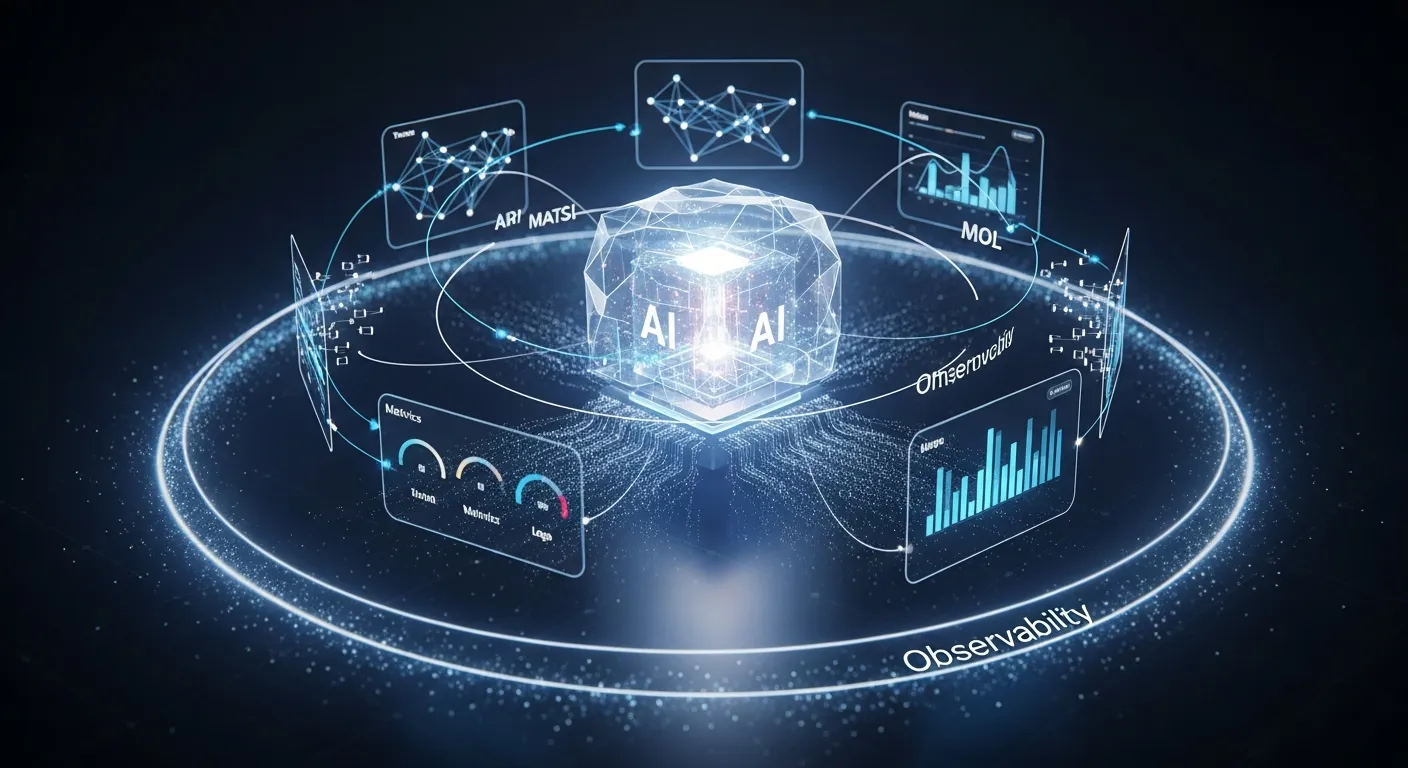
Observability is the ability to infer the internal state of a system based on the data it produces. In AI environments this means collecting traces of model execution, metrics about latency and resource usage, and logs that capture errors or business events. OpenTelemetry offers an open standard that brings together these three signals into a single, vendor neutral framework.
Architecture Overview
The OpenTelemetry architecture consists of four main layers. At the bottom are the instrumentation libraries that automatically or manually capture telemetry from frameworks such as TensorFlow, PyTorch or Spark. The data is handed to the OpenTelemetry SDK which enriches it with context and applies sampling policies. The SDK then forwards the telemetry to the Collector, a configurable agent that can receive, process and export data to multiple backends. Exporters translate the data into formats understood by observability platforms, cloud services or custom storage solutions.
Key Components
- OpenTelemetry SDK
- Collector
- Exporters
- Instrumentation Libraries
How It Works
When an AI model starts a training epoch, the instrumentation library creates a span that represents the operation. Inside the span, metrics such as GPU utilization, batch processing time and loss values are recorded. Logs generated by the framework are attached to the same context. The SDK batches this information and sends it to the Collector, which can filter, aggregate or enrich the data before forwarding it to a backend like Prometheus, Jaeger or a cloud monitoring service. This end to end pipeline gives engineers a correlated view of traces, metrics and logs for every model run.
Use Cases
- Model training pipeline monitoring
- Inference latency tracing
- Data drift detection
Advantages
- Vendor neutral standard reduces lock‑in and simplifies migration between monitoring tools
- Unified telemetry across traces, metrics and logs enables faster root cause analysis
Limitations
- Initial instrumentation effort can be high for legacy AI codebases
- High‑frequency data from large models may increase storage costs if not sampled wisely
Comparison
Compared with proprietary agents from vendors such as Datadog or New Relic, OpenTelemetry provides the same core capabilities without tying you to a specific backend. Proprietary solutions often bundle extra features like out‑of‑the‑box dashboards but they limit flexibility and increase cost when you need to switch providers. OpenTelemetry lets you choose the best combination of collectors, exporters and storage that fits your AI workload.
Performance Considerations
Telemetry collection adds CPU and network overhead, especially when capturing high‑resolution metrics from GPU intensive workloads. Using adaptive sampling, batch processing in the Collector and limiting the number of exported attributes can keep overhead below a few percent of total compute time. It is important to benchmark the impact on training throughput before enabling full fidelity tracing in production.
Security Considerations
Telemetry may contain sensitive data such as input samples, model parameters or user identifiers. Encrypting data in transit with TLS, redacting personally identifiable information at the instrumentation layer and applying strict access controls on backend storage are essential practices. OpenTelemetry supports secure exporters and can integrate with secret management solutions to protect credentials.
Future Trends
By 2026 the observability landscape for AI will include model‑aware telemetry standards that capture embeddings, inference token streams and concept drift signals. OpenTelemetry is expected to evolve with native support for LLM ops, edge AI devices and automated anomaly detection powered by generative AI. Integration with AI‑first monitoring platforms will allow real‑time feedback loops that automatically tune hyperparameters or trigger retraining when performance degrades.
Conclusion
OpenTelemetry provides the foundation for comprehensive observability in AI systems by unifying tracing, metrics and logs under an open, extensible standard. Its vendor neutral approach, rich ecosystem and ability to scale with modern AI workloads make it an essential component for teams that need reliable insight, rapid debugging and future‑proof monitoring as AI continues to grow in complexity.